Jupiter Down Under

Jupiter Down Under

This image from NASA’s Juno spacecraft provides a never-before-seen perspective on Jupiter’s south pole.

The JunoCam instrument acquired the view on August 27, 2016, when the spacecraft was about 58,700 miles (94,500 kilometers) above the polar region. At this point, the spacecraft was about an hour past its closest approach, and fine detail in the south polar region is clearly resolved.

Unlike the equatorial region’s familiar structure of belts and zones, the poles are mottled by clockwise and counterclockwise rotating storms of various sizes, similar to giant versions of terrestrial hurricanes. The south pole has never been seen from this viewpoint, although the Cassini spacecraft was able to observe most of the polar region at highly oblique angles as it flew past Jupiter on its way to Saturn in 2000 .

NASA’s Jet Propulsion Laboratory, Pasadena, California, manages the Juno mission for the principal investigator, Scott Bolton, of Southwest Research Institute in San Antonio. The Juno mission is part of the New Frontiers Program managed at NASA’s Marshall Space Flight Center in Huntsville, Alabama. Lockheed Martin Space Systems, Denver, built the spacecraft. JPL is a division of Caltech in Pasadena.

Juno on Jupiter’s Doorstep

Juno on Jupiter’s Doorstep

NASA’s Juno spacecraft obtained this color view on June 21, 2016, at a distance of 6.8 million miles (10.9 million kilometers) from Jupiter. Juno will arrive at Jupiter on July 4.

As Juno makes its initial approach, the giant planet’s four largest moons — Io, Europa, Ganymede and Callisto — are visible, and the alternating light and dark bands of the planet’s clouds are just beginning to come into view.

Juno is approaching over Jupiter’s north pole, affording the spacecraft a unique perspective on the Jupiter system. Previous missions that imaged Jupiter on approach saw the system from much lower latitudes, closer to the planet’s equator.

The scene was captured by the mission’s imaging camera, called JunoCam, which is designed to acquire high resolution views of features in Jupiter’s atmosphere from very close to the planet.

NASA’s Jet Propulsion Laboratory, Pasadena, Calif., manages the Juno mission for the principal investigator, Scott Bolton, of Southwest Research Institute in San Antonio. The Juno mission is part of the New Frontiers Program managed at NASA’s Marshall Space Flight Center in Huntsville, Ala. Lockheed Martin Space Systems, Denver, built the spacecraft. JPL is a division of the California Institute of Technology in Pasadena.

McLaren needs a 20-year-old Compaq laptop to maintain its F1 supercar

McLaren needs a 20-year-old Compaq laptop to maintain its F1 supercar

McLaren’s F1 supercar is special in more ways than one. Even now it’s still the world’s fastest production car with a naturally aspirated engine, and McLaren only built 106 F1s in total. Jalopnik visited McLaren recently, and discovered another special aspect to the F1: a 20-year-old laptop. McLaren is still servicing the existing 100 F1s with a Compaq laptop from the early ‘90s.

“The reason we need those specific Compaq laptops is that they run a bespoke CA card which is installed into them,” explains a McLaren spokesperson to Jalopnik. “The CA card is an interface between the laptop software (which is DOS-based) and the car.” If you’ve never heard of a CA card, then Jalopnik commenter Mike Herbst helpfully explains it’s a Conditional Access card. Modern PCs use smart cards or USB keys with special access codes to access sensitive systems, and the CA card was used as custom hardware as part of an integrated system for security and copy protection.

McLaren F1

McLaren has been sourcing Compaq LTE 5280 laptops to keep servicing the F1s, but the company is “working on an new interface which will be compatible with modern laptops” so it won’t have to keep hunting for these ancient machines. For now, a 20-year-old Compaq is the key to servicing one of the world’s fastest production cars. If you’re interested in buying the F1 that McLaren is selling, you won’t be able to plug in any old laptop and disable any of those annoying dash warnings. That’s probably the least of your worries when the supercar will likely sell for more than $10 million.

NASA’s Kepler Discovers First Earth-Size Planet In The ‘Habitable Zone’ of Another Star

NASA’s Kepler Discovers First Earth-Size Planet In The ‘Habitable Zone’ of Another Star


NASA’s Kepler Space Telescope, astronomers have discovered the first Earth-size planet orbiting a star in the “habitable zone” — the range of distance from a star where liquid water might pool on the surface of an orbiting planet. The discovery of Kepler-186f confirms that planets the size of Earth exist in the habitable zone of stars other than our sun.

While planets have previously been found in the habitable zone, they are all at least 40 percent larger in size than Earth and understanding their makeup is challenging. Kepler-186f is more reminiscent of Earth.

kepler186f_comparisongraphic.jpg
The diagram compares the planets of our inner solar system to Kepler-186, a five-planet star system about 500 light-years from Earth in the constellation Cygnus. The five planets of Kepler-186 orbit an M dwarf, a star that is is half the size and mass of the sun.
Credits: NASA Ames/SETI Institute/JPL-Caltech

“The discovery of Kepler-186f is a significant step toward finding worlds like our planet Earth,” said Paul Hertz, NASA’s Astrophysics Division director at the agency’s headquarters in Washington. “Future NASA missions, like the Transiting Exoplanet Survey Satellite and the James Webb Space Telescope, will discover the nearest rocky exoplanets and determine their composition and atmospheric conditions, continuing humankind’s quest to find truly Earth-like worlds.”

Although the size of Kepler-186f is known, its mass and composition are not. Previous research, however, suggests that a planet the size of Kepler-186f is likely to be rocky.

“We know of just one planet where life exists — Earth. When we search for life outside our solar system we focus on finding planets with characteristics that mimic that of Earth,” said Elisa Quintana, research scientist at the SETI Institute at NASA’s Ames Research Center in Moffett Field, Calif., and lead author of the paper published today in the journal Science. “Finding a habitable zone planet comparable to Earth in size is a major step forward.”

Kepler-186f resides in the Kepler-186 system, about 500 light-years from Earth in the constellation Cygnus. The system is also home to four companion planets, which orbit a star half the size and mass of our sun. The star is classified as an M dwarf, or red dwarf, a class of stars that makes up 70 percent of the stars in the Milky Way galaxy.

“M dwarfs are the most numerous stars,” said Quintana. “The first signs of other life in the galaxy may well come from planets orbiting an M dwarf.”

Kepler-186f orbits its star once every 130-days and receives one-third the energy from its star that Earth gets from the sun, placing it nearer the outer edge of the habitable zone. On the surface of Kepler-186f, the brightness of its star at high noon is only as bright as our sun appears to us about an hour before sunset.

“Being in the habitable zone does not mean we know this planet is habitable. The temperature on the planet is strongly dependent on what kind of atmosphere the planet has,” said Thomas Barclay, research scientist at the Bay Area Environmental Research Institute at Ames, and co-author of the paper. “Kepler-186f can be thought of as an Earth-cousin rather than an Earth-twin. It has many properties that resemble Earth.”

The four companion planets, Kepler-186b, Kepler-186c, Kepler-186d, and Kepler-186e, whiz around their sun every four, seven, 13, and 22 days, respectively, making them too hot for life as we know it. These four inner planets all measure less than 1.5 times the size of Earth.

The next steps in the search for distant life include looking for true Earth-twins — Earth-size planets orbiting within the habitable zone of a sun-like star — and measuring the their chemical compositions. The Kepler Space Telescope, which simultaneously and continuously measured the brightness of more than 150,000 stars, is NASA’s first mission capable of detecting Earth-size planets around stars like our sun.

Ames is responsible for Kepler’s ground system development, mission operations, and science data analysis. NASA’s Jet Propulsion Laboratory in Pasadena, Calif., managed Kepler mission development. Ball Aerospace & Technologies Corp. in Boulder, Colo., developed the Kepler flight system and supports mission operations with the Laboratory for Atmospheric and Space Physics at the University of Colorado in Boulder. The Space Telescope Science Institute in Baltimore archives, hosts and distributes Kepler science data. Kepler is NASA’s 10th Discovery Mission and was funded by the agency’s Science Mission Directorate.

The SETI Institute is a private, nonprofit organization dedicated to scientific research, education and public outreach.  The mission of the SETI Institute is to explore, understand and explain the origin, nature and prevalence of life in the universe.

For more information about the Kepler mission, visit Project Page

Here’s what Nintendo’s weird U-shaped controller patent might actually be for

Here’s what Nintendo’s weird U-shaped controller patent might actually be for

Late last week a Nintendo patent application for a strange U-shaped controller surfaced in the gaming forum NeoGAF. The patent application, which was reportedly filed in October of 2014 and has been roughly translated into English, suggests that Nintendo had plans for a motion-based controller with a variety of fitness-related sensors, including a gyroscope, acceleration sensors, and temperature sensors.

“The main object of the present invention is to provide a novel training equipment, training system and an input device,” the application reads. It references use of a balance ball, and is also referred to as an “exercise appliance and health appliance.”

Even after reading a good part of the application, the horseshoe-like device is still shrouded in mystery. Here are five things the patent application might actually be for:

1. Some type of dedicated health controller that will work with Nintendo‘s next big console, codenamed NX. “NX” is expected to come out by the end of this year and has beendescribed by Nintendo as a something “unique and different,” not just the “next version of the Wii or Wii U.”

2. A non-wearable wearable that would work with Nintendo‘s stalled “quality of life” health platform, which the company first spoke about in 2014 and said would launch in April 2015 (but then never did), and now its fate seems totally up in the air…

Nintendo-patent-horseshoe-boomerang

3. An hand controller that will work with a yet-to-be-announced Nintendo AR / VR headset, which will transport us all into a magical world of warp pipes, labyrinth dungeons, and rainbow roads.

4. An actual horseshoe — but a “smart” one. If there are apps for logging saddle hoursand tracking your horse’s weight, why not make a horseshoe that will wirelessly send all of that data to an app? Horses need Fitbits, too? It would be a slight deviation fromNintendo‘s, um, stable of products, but Nintendo has done stranger things before. (Okay, we don’t really think it’s a horseshoe.)

5. Nothing. Tech companies file patent applications all the time. And Nintendo has a history of filing bizarre patent applications. This U-shaped motion-sensing controller device may never come to market.

Then again, maybe we’ll all be sitting on balance balls holding boomerang controllers in our hands, tracking our activity levels — or inactivity levels — soon enough.

Dark Matter Particle Could be Size of Human Cell

Dark Matter Particle Could be Size of Human Cell
Dark matter could be made of particles that each weigh almost as much as a human cell and are nearly dense enough to become miniature black holes, new research suggests.
While dark matter is thought to make up five-sixths of all matter in the universe, scientists don’t know what this strange stuff is made of. True to its name, dark matter is invisible — it does not emit, reflect or even block light. As a result, dark matter can currently be studied only through its gravitational effects on normal matter. The nature of dark matter is currently one of the greatest mysteries in science.
                              
If dark matter is made of such superheavy particles, astronomers could detect evidence of them in the afterglow of the Big Bang, the authors of a new research study said.
Previous dark matter research has mostly ruled out all known ordinary materials as candidates for what makes up this mysterious stuff. Gravitational effects attributed to dark matter include the orbital motions of galaxies: The combined mass of the visible matter in a galaxy, such as stars and gas clouds, cannot account for a galaxy’s motion, so an additional, invisible mass must be present. The consensus so far among scientists is that this missing mass is made up of a new species of particles that interact only very weakly with ordinary matter. These new particles would exist outside the Standard Model of particle physics, which is the best current description of the subatomic world.
Some dark matter models suggest that this cosmic substance is made of weakly interacting massive particles, or WIMPs, that are thought to be about 100 times the mass of a proton, said study co-author McCullen Sandora, a cosmologist at the University of Southern Denmark. However, despite many searches, researchers have not conclusively detected any WIMPs so far, leaving open the possibility that dark matter particles could be made of something significantly different.
Now Sandora and his colleagues are exploring the upper mass limit of dark matter — that is, they’re trying to discover just how massive these individual particles could possibly be, based on what scientists know about them. In this new model, known as Planckian interacting dark matter, each of the weakly interacting particles weighs about 1019 or 10 billion billion times more than a proton, or “about as heavy as a particle can be before it becomes a miniature black hole,” Sandora told Space.com.
A particle that is 1019 the mass of a proton weighs about 1 microgram. In comparison, research suggests that a typical human cell weighs about 3.5 micrograms.
The genesis of the idea for these supermassive particles “began with a feeling of despondency that the ongoing efforts to produce or detect WIMPs don’t seem to be yielding any promising clues,” Sandora said. “We can’t rule out the WIMP scenario yet, but with each passing year, it’s getting more and more suspect that we haven’t been able to achieve this yet. In fact, so far there have been no definitive hints that there is any new physics beyond the Standard Model at any accessible energy scales, so we were driven to think of the ultimate limit to this scenario.”

Belgian man wanted over Paris attacks is arrested

Belgian man wanted over Paris attacks is arrested

Mohamed Abrini, a 31-year-old Belgian wanted in connection with November’s Islamic State attacks in Paris, has been arrested, a police source confirmed to AFP on Friday.

Abrini has been on Europe’s most wanted list since being identified on CCTV in a car with terror suspect Salah Abdeslam two days before the attacks in the French capital on 13 November.

Abrini was at the wheel of the Renault Clio that was later used by a team of gunmen in the Paris attacks.

Abdeslam, Abrini’s childhood friend, was arrested in Brussels two weeks ago, four days before Isis suicide bombers struck the city’s airport and a metro station.

The Belgian federal prosecutor’s office confirmed it had made several arrests related to the deadly attacks in Brussels on 22 March but gave no further details.

There was no official comment on whether Abrini was also connected to the Brussels metro and airport attacks.

Belgian police are continuing to search for a third airport bomber known as the man in the hat, seen with two suicide bombers on security camera footage at Brussels airport on 22 March.

The man in the hat left a bag containing a bomb at the airport before walking out of the terminal and crossing Brussels on foot.

John Kerry: Isis is committing genocide in Syria and Iraq

John Kerry: Isis is committing genocide in Syria and Iraq

The US has declared that Islamic State is committing genocide against Christians and other minorities, amid mounting global pressure to recognise atrocities committed in Iraq and Syria as a deliberate drive to wipe out certain religious groups.

US secretary of state John Kerry said that Isis, known in Arabic by its acronym Daesh, was “genocidal by self-proclamation, by ideology and by actions, in what it says, in what believes and in what it does”.

He said: “In my judgment, Daesh is responsible for genocide against groups in areas under its control including Yazidis, Christians and Shia Muslims.”

Christians and members of other religious groups have been killed, tortured, raped and driven out of their homes. Isis has taken women and girls as sex slavesand forced children and teenagers into battle at an unprecedented rate, according to US researchers.

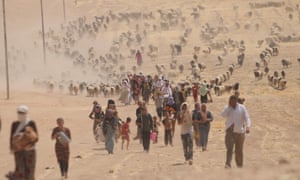
In August 2014, at least 40,000 members of the Yazidi sect were trapped on Mount Sinjar, where they faced slaughter by Isis if they fled, and dehydration if they stayed.

Kerry said the “full facts” must be established by an independent investigation and justice sought by a competent court or tribunal.

The United States would “strongly support efforts to collect, document, preserve and analyze the evidence of atrocities. And we will do all we can to see that the perpetrators are held accountable.”

He added: “I hope that my statement today will assure the victims of Daesh’s atrocities that the United States recognizes and confirms the despicable nature of the crimes that have been committed against them.

“Daesh is also responsible for crimes against humanity and ethnic cleansing, directed at these same groups and in some cases also against Sunni Muslims, Kurds and other minorities. I say this even though the ongoing conflict and lack of access to key areas has made it impossible to develop a fully detailed and comprehensive picture of all that Daesh is doing and all that it has done.”

He did not say how such a declaration would affect US involvement in areas controlled by Isis.

The announcement came amid mounting international pressure to declare the acts against Christians and other religious minorities as genocide.

Displaced people from minority Yazidi sect
Pinterest
Displaced people from minority Yazidi sect, fleeing violence from forces loyal to Islamic State in Sinjar town, walk towards Syrian border in August 2014. Photograph: Rodi Said/Reuters

Last month, the European parliament unanimously backed a resolution to label the atrocities as genocide. Presidential candidates Hillary Clinton, the former secretary of state, and Republican candidate Ted Cruz have also said they consider the acts genocide.

Barack Obama has hesitated to make such a declaration, though he has spoken about the “brutal atrocities” committed against Christians and other religious and ethnic minorities.

Last year, speaking about the Middle East, Pope Francis said: “In this third world war, waged piecemeal, which we are now experiencing, a form of genocide is taking place.”

Organisations which monitor religious persecution have warned that Christianity is in danger of being wiped out in the Middle East. Welcoming Kerry’s statement, Lisa Pearce of the global NGO Open Doors said: “It’s clear that the region is being purged of Christians and there are clear elements of religious cleansing. It’s easy to see why many people including the Pope and European Parliament have called their actions genocide.”

In his announcement, Kerry said that Shia Muslims, Christians and Yazidis were targets of genocide, but also said Sunni Muslims, Kurds and other minorities experienced crimes against humanity and ethnic cleansing at the hands of Isis.

It is not entirely clear why Kerry made the distinction between religious and ethnic groups, but Cameron Hudson, director of the Simon-Skjodt Center for the Prevention of Genocide at the US Holocaust Memorial Museum, suggested that it had to do with qualitative differences in how each group has been targeted.

“All of these groups have experienced ethnic cleansing and war crimes, it’s really though the Shia, the Yazidi and the Christian that have experienced I think a more systematic targeting based very specifically on their group identity,” Hudson said.

“There has been qualitative differences on the ground between how certain groups have been treated, in one respect,” Hudson said, adding that Isis has treated everyone “somewhat the same in the sense of they’ve just gone in and cleansed entire areas.”

Kerry’s declaration came the same week the US House voted 383-0 in favor of classifying the atrocities as a genocide against Christians, Yazidis and other ethnic and religious minorities.

The House resolution said that Christians and other ethnic and religious minorities “have been murdered, subjugated, forced to emigrate and suffered grievous bodily and psychological harm, including sexual enslavement and abuse, inflicted in a deliberate and calculated manner in violation of the laws of their respective nations, the laws of war, laws and treaties forbidding crimes against humanity”.

But some have hesitated to use the word genocide out of fear of playing into a perception of a “Christian crusade” against Islam. Others say there are simply too many unknowns. Accurate data on the killing of Christians and members of religious minorities in Iraq and Syria by Isis is impossible to obtain.

The UN 1948 convention on the prevention and punishment of the crime of genocide states: “Genocide means any of the following acts committed with intent to destroy, in whole or in part, a national, ethnical, racial or religious group,” listing killing, causing serious bodily or mental harm, deliberately inflicting conditions of life calculated to destroy the group in whole or in part, preventing births and the forcible transfer of children.

The convention compels nations that recognize genocide to prevent and punish those responsible, but intervention is not mandatory, rather it is how the declaration has been interpreted in the decades since it was enacted.

Further, the legal and policy architecture of the genocide convention is predicated on the idea that states or countries commit this crime, but this declaration challenges that assumption, said Hudson.

“Now that we’re acknowledging that Isis, a non-state group, has the power and the intention to commit this crime, it represents a very new challenge to how we treat terrorist groups and what our policy is for combatting it, because it’s not simply about defeating Isis now, it’s also about holding them for accountable for these crimes,” Hudson said.

US-led airstrike in Kobani Syria
Pinterest
Heavy smoke rises following an airstrike by the US-led coalition aircraft in Kobani, Syria, during fighting between Syrian Kurds and Isis militants. Photograph: Gokhan Sahin/Getty Images

The US has already conducted airstrikes in Syria and deployed special forces troops to Syria, Iraq and Libya to target Isis militants.

The international community still carries collective guilt over its failure to recognise the Rwandan genocide in 1994, in which an estimated 800,000 people were killed in 100 days.

The last time the US declared genocide was in 2004, when then secretary of state, Colin Powell, said the acts of killing and destruction in Darfur were genocide.

International law experts said Kerry’s declaration that Isis was committing genocide in the Middle East would be politically influential but would not in itself trigger any formal war crimes investigation.

Rodney Dixon QC, of Temple Garden Chambers, an expert in international law said: “The International Criminal Court (ICC) has jurisdiction over the territories of those countries that have signed up to it. Neither Iraq nor Syria have done so.

“However an allegation of genocide could be considered by the United Nations Security Council which could then decide to refer the situation to the ICC if it is deemed to affect international peace and security. That was done in the cases of Sudan and Libya.

“Another way the ICC could consider action against Islamic State is if the acts took place on the territory of a country that has signed up, for example France where the Bataclan massacre took place, or if nationals of States who are parties to the ICC are perpetrating crimes even on territories that are not signed up.”

Mark Ellis, executive director of the London-based International Bar Association, said: “The US has previously been reluctant to engage with the debate on genocide. By elevating this to crimes of genocide it will focus the international community’s attention of accountability.

“This may also assist other states to focus on the responsibility of all countries to help to bring to justice those who have comitted these crimes. The Genocide Convention does not have universal jurisdiction but if [the US] designates something as genocide it forces the international community to respond more aggressively to the problem.”

At the International Criminal Court in The Hague, the office of the prosecutor said: “The decision on whether to initiate an investigation as well as the selection of cases within a situation, is for the prosecutor to decide following a preliminary examination to determine whether there is a reasonable basis to proceed with an investigation.”

The court’s intervention is normally triggered by a referral from a state, the UN security council, “a non-state party accepting jurisdiction of the ICC” or the prosecutor’s “initiating an investigation using his/her own powers where s/he believes crimes falling under the jurisdiction of the Court may have been committed.”

US election 2016: Trump and Rubio row over Islam ‘hate’

US election 2016: Trump and Rubio row over Islam ‘hate’

Republican presidential hopeful Marco Rubio has attacked Donald Trump for saying that Islam hates America, in a televised debate in Miami.

Mr Rubio, who faces a do-or-die contest in Florida on Tuesday, said Islam had a problem with radicalisation but said that many Muslims were proud Americans.

“Presidents can’t just say whatever they want. It has consequences,” he said, to cheers from the audience.

The four Republicans heeded pleas from party leaders to have a civil debate.

Unlike in the last TV event, which was littered with personal insults, this one was more substantive with a focus on policy.

“So far, I cannot believe how civil it’s been up here,” Mr Trump observed at one point.

But on the issue of Islam, there was clear distance between Mr Trump and the others. Mr Trump stood by comments he made earlier in the day when he said “Islam hates us, there’s a tremendous hatred”, and railed against political correctness.

But Mr Rubio said: “I’m not interested in being politically correct. I’m interested in being correct.”


Analysis: Anthony Zurcher, BBC News, Miami

It’s now clear that the remaining candidates in the Republican field have run out of ideas on how to stop Donald Trump’s march to the Republican nomination.

In early debates the top-tier candidates largely ignored the New York billionaire, hoping he’d self-destruct on his own. In the past few showdowns, they’ve gone after him relentlessly.

Now, in this 12th event, they started by avoiding confrontation, then prodded him only ever-so-gently.

“I can’t believe how civil it’s been up here,” Mr Trump said at one point.

Given that Mr Trump has a lead in convention delegates and is ahead in many of the states set to vote on Tuesday, a fireworks-free debate is nothing but good news for the front-runner.

While Marco Rubio and Ted Cruz tried to draw contrasts with Mr Trump on issues like foreign policy, trade protectionism and his reliance on anti-Islamic rhetoric, the enthusiasm just isn’t there anymore. Mr Cruz, in particular, launched most of his barbs with sighs and head-shaking resignation, rather than ferocity.

This race isn’t over yet, but Thursday night’s proceedings show that – barring some sort of massive upheaval – the end is likely in sight.

Read Anthony’s analysis in full


All three of Mr Trump’s rivals distanced themselves from Mr Trump’s statement in December that in the fight against terrorist “you have to take out their families”.

“We’ve never targeted innocent civilians and we’re not going to start now” Mr Cruz said.

When Mr Trump was challenged on the legality of targeting civilians, he said that America had to be able to fight on “an equal footing”.

“We have to obey the laws, but we have to expand those laws”, he said.

On Tuesday five large states will vote for presidential candidate in each party, with Ohio Governor John Kasich and Mr Rubio, a Florida senator, under pressure to win their home states.

Marco Rubio and Donald Trump

Mr Trump picked up a key endorsement of Ben Carson, who last week dropped out of the race before the debate.

Debate highlights:

  • Mr Trump reaffirmed his opposition to H1-B visa programme, which allows US firms to employ highly skilled foreigners, saying “it’s bad for our workers”
  • Mr Rubio said he would delay retirement until 68 to help address the $150bn social security shortfall
  • And he accused Mr Trump’s numbers of “not adding up” because he said he could save social security by eliminating waste
  • Mr Cruz said he was going to build a wall, triple the border control and end welfare benefits for undocumented
  • Mr Trump said he would “make education great” and that former Republican candidate Ben Carson would be involved
  • And calling Vladimir Putin “strong” did not mean he was endorsing him as a good leader, said Mr Trump
  • Mr Kasich disagreed with Mr Rubio, who said he did not believe in manmade climate change

The candidates also clashed over President Barack Obama’s historic visit to Cuba next week.

Mr Rubio, whose parents were Cuban immigrants, said he was opposed to efforts to restore relations until Cuba improved its human rights record.

But Mr Trump said he was not opposed to a US-Cuba deal, but it should be on better terms for the US.

The other Cuban-American candidate on the stage, Mr Cruz, accused Mr Trump of supporting the Obama-Clinton policy on Cuba

Debate Guidelines by Karl Popper.


I. Introduction

The Karl Popper Debate format focuses on relevant and often deeply divisive propositions, emphasizing the development of critical thinking skills, and tolerance for differing viewpoints. To facilitate these goals, debaters work together in teams of three, and must research both sides of each issue. Each team is given the opportunity to offer arguments and direct questions to the opposing team. Judges then offer constructive feedback, commenting on logical flaws, insufficient evidence, or arguments that debaters may have overlooked.

Karl Popper debate should:

• focus on the core elements of controversial issues

• emphasize tolerance for multiple points of view

• emphasize the development of analytical thinking skills

• instill in participants an appreciation for the value of teamwork • provide students with the opportunity to debate many kinds of resolutions

II. Karl Popper Rules

The following rules, which define the goals and procedures of Karl Popper Debate, are intended to ensure that participants enter into the debate sharing a common set of expectations. Judges may not impose additional rules on debaters

. The judge’s decision in a debate round is final. Violations of these rules may merit (at the judge’s discretion) a reduction in points, or a loss in a given round. In the case of serious rule violations, a judge should consult with the Tournament Director before imposing sanctions on the debaters.

The Tournament Director, or a committee designated by the Tournament Director, may impose penalties including reprimands and, in extreme cases, the removal of a debater or judge from the tournament. Penalties may affect future rounds, but cannot reverse judges’ decisions. Cases of intellectual dishonesty are the sole exception: in these cases, a Tournament Director may reverse a decision, provided that the reversal takes place prior to the scheduled start of the next round.

Tournament Directors (with the approval of the IDEA Accreditation Committee) are permitted to make minor changes to these rules. To gain the committee’s approval, the changes must be submitted at least one month prior to the beginning of the tournament. The Accreditation Committee will then approve or reject the changes, and inform the Tournament Director of its decision.

 A. Resolution and Preparation

1. In Karl Popper Debate, many kinds of resolutions are appropriate. Resolutions should target the core elements of a controversial issue, and be carefully worded to provide fair ground for debate.

2. The duty of researching falls primarily to the debaters, not to their teachers and coaches.

3. In order to allow for adequate research and preparation time, students will be notified of the resolution in advance; ideally, the topic should be disclosed one month prior to a tournament.

B. Interpretation of the Resolution

1. The affirmative team has the responsibility to define and interpret the resolution. The affirmative should interpret the topic as it would reasonably be interpreted in the public sphere. The affirmative need not necessarily provide a literal interpretation of the resolution; rather, the objective of the affirmative team is to make an adequate case for its interpretation of the resolution. To this end, the team must introduce one or more arguments in support of the resolution as they have interpreted it, and sustain that case throughout the debate.

2. The negative team argues against the affirmative position. The negative team may counter the affirmative team’s interpretation of the resolution if they believe it is not reasonable. The negative team may challenge any aspect of the affirmative team’s case, and may offer a case of its own. For example, it may challenge the interpretation of the resolution, the factual and analytical foundations of the case, or the underlying assumptions of the affirmative’s claims.

C. Rules During Karl Popper Debate

1. No research is permitted. Topic research must be completed prior to the beginning of a debate. Once the debate begins, the participants may not conduct research via the Internet, nor through electronic or other means.

2. No outside assistance is permitted. No outside person(s) may conduct research during the debate and provide information directly or indirectly to the debaters. Debaters, however, are allowed to consult whatever research materials they have brought with them to the debate.

3. Debaters should be able to provide sources for direct citations. When debaters refer to any public information, they should be prepared to provide, upon request, complete source documentation to the opposing team and to the judge. A team’s documentation of cited material must be complete enough for the opposing team and the judge to locate the information on their own. Ordinarily, such documentation would include the name of an author (if 3 any), the name and date of a publication (and a page number, if available), or the URL of a Web site.

4. Debaters should practice intellectual honesty. Students should cite arguments and statistics truthfully, and never fabricate sources or data.

5. Debate should be approached as a team activity. Each debate team is composed of three individuals who will speak in the roles they announce at the start of the debate. Debaters may change their role in the debate from round to round.

III. The Karl Popper Debate Format

A. The affirmative and the negative teams will have equal time to present their arguments.

1. The debate is composed of ten parts. Six of these consist of speeches – that is, uninterrupted presentations by a designated speaker. The remaining four consist of cross examination – that is, a series of questions and answers involving one speaker from each side.

2. The following is a breakdown of the Karl Popper debate format

lo

3. Each debate also includes sixteen minutes of preparation time (eight minutes for each team). This time is not scheduled in any particular place in the speaking order, but is instead taken at the discretion of each team, in whatever amounts the team desires, prior to a cross examination or an upcoming speech.

B. Each speech and each questioning period has a specific purpose.

1. Affirmative Constructive (1A) In this speech, the affirmative team is expected to offer its complete argument in favor of the resolution. Although later affirmative speakers may repeat points and expand on them later in the debate, the first affirmative speaker must present the entirety of his or her team’s case, including whatever criteria or definitions the team views as instrumental.

2. First Negative Cross-Examination The two debaters are expected to face the audience (as opposed to each other). The negative debater is expected to ask questions rather than make speeches. The affirmative debater is expected to answer these questions; he or she should 4 not make speeches or ask questions in return. The affirmative debater may make concessions during this cross-examination, but it is incumbent upon the negative team to capitalize on these concessions in the speech that immediately follows. Team members should not assist their teammates by offering suggestions or by answering questions on their behalf. During the cross-examination period, only the examiner may ask questions and only the speaker may answer them. No spoken communication between either the examiner, or the speaker and his or her teammates, is allowed.

3. Negative Constructive (1N) Like the affirmative team in its constructive, the negative team is expected to offer a complete argument against the affirmative’s position. The affirmative’s definition, if not challenged at this point, should stand. Similarly, if the negative does not offer competing criteria, it is assumed that the criteria articulated by the affirmative team will govern the round. Finally, the negative team must challenge the affirmative’s arguments; otherwise, it will be assumed that these arguments are acceptable.

4. First Affirmative Cross-Examination The rules of procedure for the “First Negative Cross-Examination” also apply here.

5. First Affirmative Rebuttal (2A) The affirmative speaker has two tasks in this speech. First, he or she must outline their refutations of the negative arguments. Second, he or she must respond to the refutations made by the negative team (that is, the negative’s objections to the affirmative case). If the affirmative speaker does not refute a given point in the negative case, then the point stands; if the affirmative speaker does not respond to a particular negative objection, then the objection is conceded. New evidence for existing arguments may be presented.

6. Second Negative Cross-Examination The rules of procedure outlined above, under “First Negative CrossExamination” also apply here.

7. First Negative Rebuttal (2N) As with the affirmative rebuttal described above, the negative speaker has a dual task: first, he or she must respond to the refutations made by the affirmative, and second, he or she should continue to attack the affirmative case. At this point in the debate, the negative speaker may start to draw the judge’s attention to points that have been dropped. That is, he or she will indicate items to which affirmative has not responded. Such a dropped point is treated as a concession made by the affirmative team. New evidence for existing arguments may be presented.

8. Second Affirmative Cross-Examination The rules of procedure outlined above, under “First Negative CrossExamination,” also apply here. 5

9. Second Affirmative Rebuttal (3A) The task of the affirmative speaker in this speech is reactive. He or she should renew refutations that have not been addressed adequately. Usually, this means pointing out flaws in the negative rebuttal. At this point, most good debaters will deliberately let some points drop and will focus the judge’s attention on the key issues in the round. The speaker may or may not instruct the judge; that is, the speaker may or may not articulate a standard of judgment for the round. New evidence for existing arguments may be presented.

10. Second Negative Rebuttal (3N) In essence, the second negative rebuttal is similar to the second affirmative rebuttal. Judges should be especially wary of speakers introducing new arguments at this point since the affirmative team has no chance to respond, so a new argument is especially unfair. The judge should ignore any new arguments that are introduced.

IV. The Role of the Judge

For guidelines in judging any speech or debate event, please refer to Judge Accreditation Process and Standards.

A. Prior to accepting a Karl Popper judging assignment, a judge must agree to:

1. conduct the debate on the basis of these standards

2. enforce all rules that fall within the judge’s province

3. not add, enforce, or base a decision on any rules not included in these standards

B. In Karl Popper Debate, the judge should consult with tournament administrators in order to be aware of tournament rules regarding oral critiques and the disclosure of decisions.

C. Under no circumstances can the judge change his or her decision or points based on any discussions with the teams involved.

D. Judges decision should be based on the content of the debate. The content of the debate includes the substantive arguments presented in a debate along with the supporting evidence used to support them. As long as the speakers communicate their ideas clearly, it does not matter if they used sheets of paper instead of note cards, or if they read parts of the speeches. Naturally, the style of speaking affects the ability to persuade. However, though it is more persuasive if speakers do not read their speeches, they should not be marked down heavily unless it impinges on the speakers’ ability to convey their arguments clearly and persuasively to the audience. Structure is generally more important than communication style, as it determines whether the speakers presented clear arguments. A good question for judges to ask themselves is: At the end of the debate, was the audience left with a clear impression of the team’s arguments? 6 D. Judges should make their decision on which team won or lost the debate based on the performance of the team as a whole. Some tournament directors may permit judges to award wins to teams that receive lower total speaker points.